History and Interpretation of Poomsae in Taekwondo
Many Taekwondo practitioners have questions with regard to the age and purpose of the poomsae, tul, or forms that they incorporate into their martial arts study, whether in competition, for promotion, demonstration, or simply for traditional practice. In order to understand the role of poomsae within Taekwondo, it is necessary to trace it to Karate and various Chinese martial arts. These arts that preceded Taekwondo held the practice of forms as fundamental, if not central, to their physical training and personal development. It must be underscored that the masters who created Taekwondo would have studied these art forms and would certainly have had their function in mind during the creation of the poomsae of Taekwondo. A deeper understanding of the origins of poomsae can assist in the pursuit of an appropriate and compelling interpretation of the poomsae.
History of Forms in Martial Arts
Martial arts systems most likely developed in response to the need for large quantities of military troops to be trained in simple and effective techniques, especially when wielding weapons. The tactics and techniques could be learned quickly and applied effectively on the battlefield through systemized martial arts training. The forms thus assume enormous efficiency and pedagogical value for those in charge of training because hundreds of soldiers could train with effective techniques in open space simultaneously; they were the earliest non-combative and non-competitive display of martial arts and were constructed of the very strikes, blocks, and stances used in combat. In this sense, they function as a catalogue of specific maneuvers that successful military regiments deployed.
During China’s turbulent years, especially throughout the Han dynasty and the Warring States Period of China, the 5th century B.C.E. ending with the Qin State victory in 221 B.C.E, the forms carried the additional function of training and coordinating troops on the battlefield through the use of drum accompaniment [Lorge 2012: 29]. It was also during this time that centralized military favoring infantry units was evolving out of the chariot warfare that was favored by the independent aristocracies [Gernet 1982: 66]. Scholars aren’t sure precisely how they are drumming connected to forms, but there are some early accounts that suggest a spatial relationship. For instance, in one text, Spring and Autumn Annals of Wu and Yüeh, drumming is used to direct the motion of a group of servants posing as infantry:
[Sun Tzu] instructed them in military methods, that in accord with the drum they should advance, withdraw, go left or right, or turn around…He again beat the drum, and they went left and right, advanced and withdrew, and turned around in accord with the prescribed standards without daring to blink an eye.
[Sawyer 1994: 81-2]. The ancient military training included provisions for the spatial movements, at the very least, that are reflected in the turns, advancements, shifts, and lateral movements contained within the martial arts forms of modern martial arts.
Forms practice during this time may have included some open hand combat techniques, but weaponry-based forms were still the priority for battlefield training. In fact, weapons training tended to be a highlight of many martial arts systems until at least the 16th century C.E., when open hand combat techniques began to gain in popularity, as an effect of the emerging Shaolin styles [Sahar 2008: 113]. Further, the advent of gunpowder a couple of centuries prior changed the technology of warfare, causing old weapons like the staff and sword to take a backseat role as a war weapon.
These events marked a major turning point in the construction and use of martial arts forms. Rather than operating on limited movement schemes dictated by the use of a handheld weapon, forms could become virtually limitless in what is represented by two free hands. Furthermore, the centuries of relative peace, especially during the Ming Dynasty from the 14th to the 17th century C.E., martial arts began to take on a different role in society. Creativity, expression, and public demonstration forged martial arts forms; aesthetic entertainment becomes the primary focus of many martial arts systems, leading to public demonstrations that were more successful when the forms displayed elaborate and interesting techniques [Lorge 2012: 134]. Animal impressions, like the crane or tiger, or other impressions from life, like drunkenness, began to be incorporated into the forms. Martial arts became known as arts as a result of this evolution [Reach 2015: 6].
As each generation of students and teachers guarded and performed their uniquely ornamented forms, many thousands of styles of Chinese martial arts emerged. Scholar Peter Lorge writes, “what distinguishes one style from another is which techniques are not used, how techniques are combined, what forms…one performs, and the emphasis given to to certain techniques over others” [2012: 207]. In fact, some schools may have only used one form, which would effectively summarize the entire martial art [O’Neil 2008: 20-1].
Forms and Philosophy
Perhaps one of the most definitive times in the history of modern martial arts is the period connecting the Qing and Ming Dynasties, that is, the 16th through the 18th centuries, so relatively recent. In these years, the specific styles of Taiji Quan, Xingyi Guan, Baguashang, Hsing-I, and Shaolin Monk’s Fist Boxing emerged. Unique to these arts is the explicit incorporation of philosophical or spiritual cultivation [Sahar 2008: 3]. The practice of spiritual cultivation is referred to as qigong and is marked by the harmonization of the body and freeing the flow of energy within. The processes and theories of qigong became the underlying foundations for forms practice: “The…sequence of fighting postures…creates patterns only to destroy them, thereby liberating the practitioner from preconceived notions” [Sahar 2008: 2]. Baguazhang, for example, draws its principles from the I Ching and teaches them through the forms:
In learning bagua, the concept is that the students are not simply learning a series of movements in a form: they are expected to learn principles and methods behind the creation of these movements. Learning the form in and of itself is a nice exercise in coordination and memory, but without the principles behind it, it is nothing more than a series of gestures.
[Joern 2012: 91]. In this model of forms practice, the performance of a whole form transcends the performance of any part of it; one can both learn to punch and kick and also come to a heightened understanding about life and self.
By the 19th century, the thousands of styles of martial arts that previously existed had begun merging with each other, either because they were too small to make it in the market or to unite with a more successful school [Lorge 2012: 205]. Which schools and styles merged together depended on the similarities and compatibilities of their techniques and forms. Naturally, this resulted in more marked distinctions between the various styles, while teachers became experts at many integrated arts. Schools would teach several forms, according to their teaching interests of combat and philosophy.
From China to Japan
During the 17th and 18th centuries, lineage of martial arts is difficult to establish, partly due to the issue that legend and historicity are sometimes overlapped. Tracing the lines broadly, rather than specifically, is still sufficient for finding the origins of modern Taekwondo poomsae. Two different lines of inquiry stand out as the most plausible candidates: the White Crane style and the other is through two original masters, known here as the Wong-Kusanku style.
The first line can be traced between various styles of early Karate and the White Crane School of Chinese martial arts [“Ryu Ryu Ko…” 2016; Reach 2015; “Kanryo” 2016]. The White Crane style originated from a combination of the Monk Boxing styles of the Shaolin temple, the Black Tiger Fist style, and the attack-defense movements of a white crane. It was taught at the Shaolin temple during the 17th and 18th centuries, where Chinese master Ryu Ryu Ko is said to have studied with a teacher who was among the foundr’s first students. The names of forms that were taught at this time include Sanchin, Seisan, Sanseiru, Seyonchin, and many others; some of these are still practiced today.
Among those who trained with Ryu Ryu Ko are Wai Xinzain and Kanryo Higa(shi)onna; Arakiko Seisho trained with Wai Xinxain; Gichin Funakoshi studied with both Arakiko Seisho and Kanryo Higa(shi)onna, bringing the trainings from his Okinawan masters to Japan. Of the original creators of Taekwondo, many studied directly or indirectly with Funakoshi while in Japan. Figure 1 shows the network of the White Crane lineage as it is traced from China to Okinawa, to Japan, and finally to Korea.

FIGURE 1: White Crane Lineage
Of the five Korean masters listed in the chart, only those with solid lines trained under Funakoshi directly. Choi Hong Hi trained at Funakoshi’s Shotokan Karate school and Hwang Kee is reported to have studied Funakoshi’s written works.
The second line of inquiry uncovers the ancestry of the forms of Bassai, Kusanku, Hakutsura, and the Pinan set (developed more recently by Anko Itosu), which have a more rustic and rigid approach to technical training than the White Crane style. This lineage dates back to the 17th century [“Traditional Japanese…” 2016; “Mississippi Isshinryu…” 2016]. It begins with a Chinese martial artist named Wong Chung-Yoh who studied Hsing-I, and the mystical master Kusanku. These two masters trained a series of Okinawan students, who transferred their teachings to Itosu, who in turn was one of the teachers of Funakoshi as well as Kanken Toyoma, both from Japan. Toyoma was the teacher of Korean Byung In Yoon, one of the original masters who founded modern Taekwondo. The lineage is shown in Figure 2.
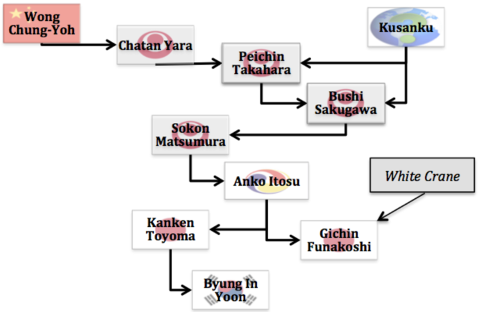
FIGURE 2: Wong-Kusanku Lineage
By the turn of the 20th century, many of the forms, now termed “kata” in the developing Karate styles, would be the hallmarks of the various schools and became crystallized into what they remain today. In some schools, the kata was the only way material was taught and practiced. The information contained within the kata, both the spiritual and the combat, were imparted to the founders of modern Taekwondo: Choi Hong Hi, Won Kuk Lee, Byung In Yoon, Byung Jik Ro, Sang Sup Chun, and Hwang Kee. The impetus for their training was the Japanese occupation, during which time such training in martial arts, and premium academic education in general, was available only by traveling to mainland Japan. The inspiration for creating a Korean martial art would be the libration and nationalism movement in Korea following World War II.
From Japan to Korea
The Yi Dynasty in Korea began in the 14th century and ended with the annexation of the Korean peninsula by Japan in 1910; King Kojong was the penultimate ruler of the dynasty, ruling from 1864 until 1907 and assumed the throne at 12 years of age, at a time when Korea was divided in thought between total national independence and opening up to foreign influence by Britain, Russia, Japan, and the United States [“Korea, 1800-1910”]. The first major conflict was with Japan in 1876, involving the attack of Japanese vessels in Korean waters and it led to the Treaty of Kanghwa, which was a major milestone in Japan’s advance into Korean affairs by opening Korea up to commerce with Japan.
Perhaps resulting from the treaty, several Korean student groups would proceed to study in Japan. Several treaties followed which continued opening Korea to trade agreements with many other countries, including Russia. Meanwhile, Korean citizens were divided in thought on whether or trade with neighboring countries would undermine their sense of national pride. In 1896, a Korean insurrection caused by Korean nationalists prompted King Kojong to seek refuge at the Russian legation. This would increase tensions between Russia and Japan to the brink of war. Two treaties were subsequently signed between Russia and Japan, essentially leaving Japan in control of Korea’s economic matters. In 1904, Japan would lead a military attack on Russian installations at Lüshun, initiating the Russo-Japanese war. Japan took the opportunity to seize control of Seoul. The war ended a year later, overseen by U.S. President Theodore Roosevelt, in a treaty that basically acknowledged that Japan had priority in Korean interests.
Japan would exercise their authority under the treaty to remove Kojong from leadership and install his son Sujong, with Japanese advisors, in 1907. In the same year, Korea’s army was disbanded. In 1909, civilian practice of any fighting martial arts was prohibited; one wishing to train in martial arts needed to travel or practice in secret [Burdick 1997: 33]. Three years later, Japan inserted General Masatake to oversee the annexation of Korea, which would formally take place later that same year. Japan would proceed to push Japanese as the language of the Korean peninsula, kill over 20,000 Korean rebels, and attempt to diminish the Korean identity.
During World War II, Japan would use Korean men by force in their army and used more than 100,000 Korean women as “comfort women,” or slaves for the Japanese soldiers [Gillis 2011: 24-31]. The consequence of this treatment of the Korean people was a movement to reclaim the Korean identity in language, poetry, culture, and art. Furthermore, there was a newfound sense of nationalism that invigorated the Korean people, including those individuals who travelled to mainland Japan for academic study. They would seek out martial arts training in the face of bullying and hardship experienced as Korean students at educational institutions. They would have the motivation and capability to take their learning in Japanese Karate and redesign and promote it in a way that would eventually lead to a Korean National Sport, or “Kukki-Taekwondo”.
Birth of Taekwondo and its Poomsae
The liberation of Korea in 1945 marked the reestablishment of Korea’s independence and allowed Koreans to express and develop their sense of nationalism. The martial arts masters who had studied Karate in Japan during their academic pursuits began to find niches for their martial arts teaching back home in Korea. They would eventually establish nine original martial arts gyms in Korea, or “kwans,” throughout the 1940’s and 1950’s. Table 1 shows the founders, who they learned from, and the kwan they established.
Founder | Kwan | Logo |
Won Kuk Lee (Funakoshi) | Chung Do Kwan (1944) |  |
Byung Jik Ro (Funakoshi) | Song Moo Kwan (1945) |  |
Hwan Kee (Shotokan Karate text) | Moo Duk Kwan (1945) |  |
Sang Sup Chun (Funakoshi) | Ji Do Kwan (1946) |  |
Byung In Yoon (Toyoma) | Chang Moo Kwan (1946) |  |
Lee Kyo Yoon (Ji Do Kwan) | Han Moo Kwan (1954) |  |
Choi Hong Hi (Shotokan Karate) | Oh Do Kwan (1954) |  |
Park Chul Hee & Hong Jong Pyo (Chang Moo Kwan) | Kang Duk Kwan (1956) |  |
Lee Yong Woo (Chung Do Kwan) | Jung Do Kwan (1956) |  |
Table 1: Nine Kwans and their Founders
The kwans referred to their martial arts by names other than “Karate”, including “Tangsudo” and “Kongsudo” [Burdick 1997: 40]. At this time, curriculum focused on simple and efficient techniques, both for self-defense training and for public demonstrations such as breaking tiles and choreographed fight scenes. For example, Lee Won Kuk’s Chung Do Kwan taught hand techniques that consisted of a punch, spear hand strike, knife hand strike, palm smash, ridge-hand strike, single and double finger strikes, back fist, and tiger claw [Gillis 2011: 37]. The same used front kick, roundhouse, back kick, and side kick. Their occurrences in the poomsae that would soon be developed are central to what those original founders believed were essential techniques, as it was imparted to them by their own instructors.
It is believed that most kwans continued to teach those forms the masters had learned in Japan, often given modified names or Korean pronunciations. For example, the form Kushanku, still used today in some specific areas of Karate, was titled “Kum-sang-kun” in the Moo duk Kwan and is still used for promotion in some dojangs. Essentially, these forms are the same, with minor variations in stance length, target height, or timing. While each master instructor of the kwan was a major player in the construction of the poomsae, either by counsel or through a representative, Choi Hong Hi was the first to pave the path of poomsae development when he created a set of forms specifically for a new Korean-made art.
Choi Hong Hi and the Chang Hon Tul
Many Taekwondo gyms will recognize Choi as a major contributor to Taekwondo. The International Taekwondo Federation (ITF) credits him almost solely as the father of Taekwondo. He is certainly among the first Koreans to bring the art of Karate back to the homeland from Japan during the occupation. In addition, he would pioneer the marketing of Taekwondo by international travel and promoting it as a national image.
Choi’s training began shortly after arriving in Japan in 1938 for academic study. His parents had pushed him to study in Japan because the educational opportunities there were much better than in the occupied homeland [Gillis 2011: 21; the following summary is from this source]. He began his training at a Shotokan school, practicing diligently there for four years before returning home at 24 years old. It is here that Choi would be introduced to the kata that would certainly have included the Okinawan forms of Bassai, Kushanku, the newer Pinan series and possibly the other White Crane styled forms. During the war, Choi was one of the men forced into the military, but participated in a failed revolt and was imprisoned until the liberation. After the division into North and South Korea, Choi was made a Lieutenant in 1946 during time when the United States was helping South Korea rebuild its military. He was in charge of training soldiers.
Because he felt shame in teaching a Japanese art to his soldiers, he redeveloped his martial arts teaching into a distinctly Korean martial art and would later market it internationally throughout the next nine years. In 1954, he, along with a younger student of Won Kuk Lee of the Chung Do Kwan named Nam Tae Hi, would establish the Oh Do Kwan, the military martial art academy [Reach 2015: 56]. It is important to note that these two men brought with them a lot of experience in applying martial arts skills in real-life situations. Choi especially had experience defending himself as a civilian before he started a military career [Gillis 2011: 30]. Both men had fought in the Korean war, as soldiers and leaders of units, in situations of hand-to-hand combat where they would instantly know which techniques were most valuable for their survival [Burdick 1997: 39; Gillis 2011: 32-3; Starr 2008: 1]. In effect, the two martial artists would be keen on developing and focusing on those techniques deemed most effective and would develop their poomsae accordingly.
Choi’s Taekwondo curriculum blended forms from his own training with new forms aimed at creating a Korean identity for the new martial art [Chun & Cook 2013: 26]. Among the Karate forms retained, Choi taught the Pinan series, called “Heian” by this time, as well as several other miscellaneous forms like Bassai and Kushanku [Burdick 1997: 35]. In addition, he taught forms he himself had created, called the Chan Hon forms, “tul”, which would eventually constitute the canon of forms for the ITF. These forms are no doubt inspired by the styles of Karate and parts of the White Crane school, but incorporate a distinct Korean style by the kicking, which was possibly derived from Taekkyon, a Korean art or game of circular kicking and sweeping. In addition, each form was infused with a prideful spirit of Korea, by title and by design. Choi’s students and the representatives of the other kwans would use a similar process, blending their prior training with interesting kicks and incorporating Korean philosophies, when developing the new forms for Taekwondo.
The First Poomsae of Taekwondo
Korea’s newfound independence and emerging engagement in commerce with the rest of the world prompted the first generation of Korean masters to seek fortification through unification. Through involvement with the Korean Athletic Association, they would find it easer to bolster their Korean-made martial art alongside the other Korean cultural exports. Unification would prove to be difficult; differences of management and diverging viewpoints on curriculum would cause friction.
Even before its formal conception, politics disrupt the proceedings of the Korean Taesudo Association, the first organization founded to unite the various kwans. By 1962, the organization evolved into the Korean Taekwondo Association (KTA), using the name “Taekwondo” officially for the first time, though this new martial arts name may have been used as early as 1955. The KTA had Choi as president but was unable to bring the Ji Do Kwan or the Moo Duk Kwan into the organization [Burdick 1997: 40-1]. Choi would establish a demonstration team throughout the 1960’s and had some temporary financial backing from the Korean government for travel and performances of the new Korean art.
At the time, the KTA required forms from the lineages of Karate for promotion, including Bassai (“Passai”), Kushanku (“Kun San Kung”), and the Pinan series (“Pyong Ahn”), among various others [Chun & Cook 2013: 37]. Alongside these requirements, individual kwans within the KTA required some of their own traditional forms. Choi’s Oh Do Kwan would require his own Chang Hon forms for promotions.
The KTA had many reasons to create a new set of forms for Taekwondo: the Korean nationalism movement, new unity among almost all of the kwans, entrepreneurial prospects, standardizing promotion tests, and the desire to break away from the Karate style. Important to the KTA board in the composition of the new forms was fair representation from each kwan, which meant that Choi’s Chang Hon set was excluded. Additionally, the Ji Do Kwan and the Moo Duk Kwan were still uninvolved. In 1965, a committee created the Palgwe Poomsae, a series of eight graduated forms, as well as the Yudanja Poomsae, designed for black belt ranks. The Yudanja set included an earlier version of Koryo, now referred to as “Koryo One” or “Original Koryo”. The forms were completed and deployed by 1967. These forms pay tribute to the kata of the Karate style by their construction and technical approach to self-defense combat.
The Palgwe forms were designed as one cohesive group, with similar ideas of symmetry, kihaps (yells), turns, and stance or technique choices. The forms favor the front stance and the back stance. All eight forms use the standard naranhi seogi joon bi (parallel) starting stance. They are highly reminiscent of the Pinan series: both form sets use the I-shape formation. In addition, the Pinan forms often use a low block during direction changes, feature two positions at a time during lateral movements, and incorporate yells mostly on punches. These characteristics were reactivated in the Palgwe forms.
The Palgwe forms were innovative in other ways, however. The major feature of their construction was that they were graduated, with basic techniques in the first forms becoming more complex with each subsequent form. They were designed specifically to be used for belt promotions and are coordinated with the ranks in Taekwondo. A good student would have practiced preceding forms and maintained the skills contained within them as they progressed through the ranks.
The Yudanja forms, or the black belt poomsae, were created alongside the Palgwe set. Whereas the Palgwe set featured forms that were all similar in style and ideas, each form of the Yudanja carries its own stylistic appeal. For instance, Keumgang looks different than Sipjin, not just because it has different moves in a different order but has its own style making it unique from the rest. The forms each follow a different shape on the floor, a shape that itself produces a philosophical background. They have various beginning stance and are overall vastly more complex than the Palgwe forms. They are not organized in a graduated manner.
As political disagreements between the heads of the kwans and Choi became more heated, Choi resigned from presidency of the KTA in 1966 and started the International Taekwondo Federation (ITF), which continues to practice the Chang Hon form set today [Gillis 2011: 78]. The Korean government, still backing the KTA realized two problems with the evolving organization. First, its original president was now competing with the organization through the ITF [Gillis 2011: 99]. Second, the KTA still lacked representation from two of the original kwans. The solution to both problems might be found in the insertion of government agent Kim Un-Yong to the presidency of the KTA in 1971.
The Kukkiwon and the second poomsae
One of the most important names in international Taekwondo, Kim Un-Yong would advance Taekwondo to prominence. His signature would appear on countless black belt certifications for many years and his efforts would result in Taekwondo being admitted to the Olympic games. Kim would campaign the same year of his appointment for financing the establishment of an official KTA headquarters in Seoul, known as the Kukkiwon, or “house that upholds Taekwondo” [Gillis 2011: 99]. The newly established Kukkiwon was conceptualized as a location of pilgrimage for Taekwondo athletes and masters. Among its initial goals was unifying both promotion tests for black belt ranks and technique (including poomsae) [Kukkiwon].
Shortly thereafter, Choi’s relocation of the ITF abroad would prompt Kim and the KTA to assume a new name, the World Taekwondo Federation (WTF). The WTF would become the international entity that was essentially the beneficiary for all things Taekwondo, including sanctioning tournaments, training referees, updating competition rules, certifying schools and promotions, leading workshops, instigating research, and publishing resources. Most importantly however, would be the ability of the WTF to function in the political realm, both locally in Korea and in foreign countries. The WTF would succeed in unifying all kwans and would reconvene the poomsae development committee in 1972. Many of the same members were included in this convention and would produce a new set of forms, named the Taegeuk poomsae, as well as a new version of Koryo. In 1973, the Taegeuk poomsae and the older Yudanja poomsae with the updated Koryowere adopted as the official poomsae of the WTF [O‘Neill 2008: 11-2].
Like the Palgwe, the eight Taegeuk forms were designed as one group and were graduated. They borrowed the frequency and general locations of the kihaps from the Palgwe, but travel on a different path. Unlike the Palgwe, they tend to favor the walking stance as well as the mid-level punch. The shape of stepping creates the symbol of the trigram on the floor (some scholars instead suggest the symbol is for the Chinese character for “king”). Each form represents an associated trigram by its incorporation of either one position laterally or two, creating respectively the broken bar or the solid bar. The Taegeuk forms were created to emphasize the appeal of kicking, which is a marked departure from the Palgwe forms and a step away from the Karate kata. Whereas there are only 16 kicks in the entire Palgwe set, there are over 16 kicks in the first four Taegeuk forms alone. The Palgwe and Original Koryo forms became heirloom forms while the Taegeuk and Yudanja were used for Gup (color belt) and Dan (black belt) promotions.
Poomsae in the 20th Century
The Kukkiwon estimates that around 2,000 masters were spready throughout the world shortly following the end of the Korean war in 1953 [Kukkiwon 2000: 40]. Many of them would not have learned the Palgwes or Yudanja forms prior to their departure, and instead taught their various traditional forms or creating their own. Some travelled abroad after the deployment of the Palgwe and Yudanja forms but before the creation of the Taegeuk forms. Depending on when a master departed Korea, which original martial arts school the master learned from, and their proximity to the WTF, many ideas could have been spread about the technique and practice of poomsae within the schools they would eventually come to establish.
As Taekwondo participation grew exponentially, standardizing the interpretation of poomsae technique and philosophy would prove to be a difficult charge for the WTF. Invariably at this time, during the 1970s, good information on the forms, would require travel to and from Korea. Some masters maintained high-level teaching by keeping what they had already learned. Their ability to promote their own students did not mean that they had to sever ties with the WTF and could continue to certify students internationally. It gave them flexibility in what forms to use for belt promotion and how to perform those forms.
At the same time, the inclusion of Taekwondo in the Olympic games in 1988 directed public interest toward sparring, or “gyorugi”, toward which curriculum development was also focused. At this event, over 11,000 media agents were actively capturing the enthusiasm and, for many spectators, the novelty of Taekwondo [International Olympic Committee]. Four years later, the Kukkiwon would host the first Hanmadang tournament in Seoul, a type of competition that includes many of the other elements of taekwondo, like board-breaking, weapons demonstrations, and poomsae performance. There were 1,346 competitors and approximately 3,000 spectators at the first Hanmadang [Kukkiwon, “Kukkiwon: 40…: 53]. Table 2 compares the timelines of these international competitions, 1973-2017.
Poomsae timeline | Gyorugi timeline |
1973 Taegeuk forms 1-8, and new version of Koryo introduced; poomsae standardization in its infancy | 1973 World Taekwondo Championships organized as a biennial tournament event, 1st event held in Seoul |
1975 Taekwondo accepted into the US Amateur Athletics Union | |
1986 Taekwondo is admitted as an event at the Pan-American Games | |
1988 Taekwondo is an exhibition sport at the Seoul Olympics; international audience
| |
1992 1st World Hanmadang tournament in Seoul includes poomsae and other events like weapons and breaking | |
1999 world-wide attention drawn to Hanmadang tournament held at the Kukkiwon: all previous Hanmadang winners would compete | 2000 Taekwondo is held as a official medal sporting event at the Sydney Olympics |
2001 10th World Taekwondo Hanmadang tournament marked by controversy with President Un-Yong Kim; Kim resigns presidency | |
2006 Kukkiwon releases “Kukkiwon Taekwondo DVD,” with multiple languages, which demonstrates the precise movements in Poomsae and other taekwondo techniques | |
2006 WTF holds first World Taekwondo Poomsae Championships; some gyms begin to get on board with the new competition style poomsae | 2009-2011 WTF radically alters points for sparring: under the old method 1/body and 2/head, under the new method 1/body, 3/head, turning techniques will add 1 bonus point |
2012 London Olympics feature electronic scoring to body | |
2016 WTF announces first world ranking would be introduced at the Austrian Poomsae Open in Vienna, June of the same year | 2016 Rio de Janeiro Olympics feature body and head scoring electronically |
2017 New scoring system: 1/punch, 2/body kick, 3/turning body kick, 3/head, 4/turning head |
TABLE 2: Comparing Poomsae and Gyorugi Timelines 1973-2017
In recent years, Hanmadang tournaments, international competitions, and local tournaments including poomsae as a competitive category have rekindled interest in how best to judge one poomsae performance against another. Currently, poomsae is scored on a mix of accuracy of moves and athleticism. The WTF frequently publishes resources and textbooks to ensure that there is standardization in poomsae detail, and athletes use the poomsae as a medium to demonstrate their athletic ability. Competitors modify their interpretations, timings, and nuances to resemble the latest winner’s performance. United States poomsae coach Dr. Misha Thackrey puts it simply, “The correct way to do Competitition Poomsae is whatever the largest number of Poomsae Referees will score highest!” [Thackrey 2009]. Advancements in access to media through online and print resources has helped competitors all over the world have access to the latest interpretations and nuances of the poomsae.
While competition has helped encourage students and athletes be accountable to accuracy and athleticism, creativity and individuality have become liabilities in some ways. To the contrary, forms are one part of taekwondo that can offer a rich exploration and provide a martial artist with new knowledge for many years. Accuracy and athleticism are still required, but it is possible for each poomsae artist to put their own unique stamp on the performance.
Interpretation of Poomsae
Interpreting poomsae is a difficult task. History and tradition give some tips to making choices about speed, flow, expression, and to gathering a deeper understanding of the poomsae; three theories can be harnessed in creating a valid interpretation of poomsae. Considering the aesthetic elements of poomsae makes them more interesting to watch. Scholars believe poomsae contain encoded teachings of advanced self-defense and combat techniques. Finally, the poomsae pay tribute to the deeper universal philosophies about life. Analyzing and informing poomsae performance through these three lenses can create a compelling interpretation that is unique to each martial artist.
Aesthetic approach
Taekwondo, like most other enterprises, relies to some degree on marketing. Public demonstrations became more successful when the forms were visually appealing. Choi Hong Hi, one of the original creators of taekwondo, explicitly believed in the necessity for visual appeal [O’Neill 2008: 35]. In taekwondo’s infant years, visually appealing forms performances helped to market the art internationally and inspire the audience.
This approach to interpretation relies on exploring the physical moves of the forms, and noting what types of moves or combinations make the form most interesting and appealing. Yells, symmetry, kicks, and complex movements all contribute to this. Paying particular attention to the types of athletic prerequisites (strong hips for a difficult kick, for example) are necessary in the pursuit of an interpretation informed by aesthetics. In addition, the type of rhythm, speed, and flow can help the spectator notice the unique traits of each form. Each martial artist is able to present a form differently and highlight new ideas, while maintaining the accuracy of the moves and details.
Practical approach
Novice students learn that forms are constructed using a variety of blocks, strikes, and kicks. As students advance, they may become more critical of those moves; some may not make sense or even lead to injury. To this end, scholars believe that the forms were encodings of techniques; their applications were hidden from students and interpreted only to the most senior students [Kane & Wilder 2005: 20-1; O’Neill 2008; 21]. It is possible that teachings have been lost and forms may have evolved away from how they originally were created. Giles Hopkins suggests that “such a debate about which school is right and which is wrong, which kata is more authentic or which has been changed, is really unresolvable at this point” [2009: 5].
It is very likely that the poomsae contain hidden techniques since several otherwise suspicious moves are found throughout the set. A low block with a fist or knifehand, for example, would be dangerous against a kick [O’Neill 2008: 37], as is often the conclusion of the application of the technique. For instance, Kim shows a low block is applied to stop a kick [1986:195].
In some places, a block is followed by a turn which makes little sense to apply in a real-life situation. In other places, a stance is combined with a technique that does not allow maximum efficiency, such as halfway through Taegeuk Sa Jang. Some of these types of suspicions can be applied likewise to the forms in the martial arts that predate taekwondo, martial arts which would have been studied by taekwondo’s original creators. Had the creators of taekwondo not been informed about the secret techniques, they would not have allowed these sorts of suspicious techniques to appear the poomsae; keep in mind that taekwondo’s original creators were experienced applying martial arts in real life.
While many teachings that would have otherwise been explicitly conferred may have been lost in time, their recovery can be possible. Many martial artists have discovered persuasive techniques within the forms. Figure 3 shows one example of an extraction of a hidden throw of an opponent from two moves within Keumgang.
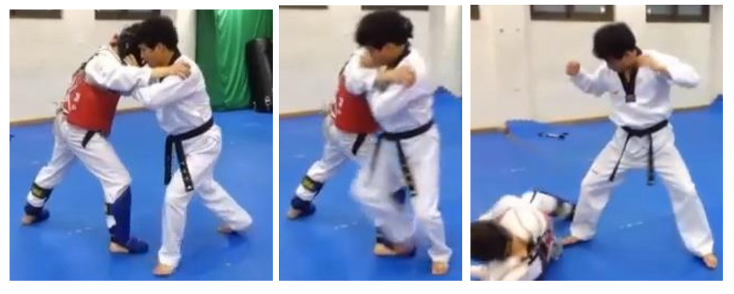
FIGURE 3: Application from Keumgang [Lee, “실전태권도…”: 0:27-0:29].
In this approach, the martial artist must employ critical inquiry and a little common sense. Each movement, technique, turn, and load can be the subject of a hidden technique. A clenched fist could be reinterpreted as a grab, strike, block, or something else. Each motion might be contributing to a larger technique and several moves could be linked together to create something larger. Upon discovery of what could be a hidden technique, the martial artist could modify the timing and flow of that part of the form to make the hidden technique more evident.
Philosophical approach
A philosophical interpretation, unlike the other methods, is concerned with the poomsae in a holistic sense; this is what elevates the collection of moves to something cohesive. The martial artist attempts to identify the meaning of the form they are practicing and studying by analyzing a variety of background and content clues. Poomsae generally deal with representing the wisdom of eastern cultures most often reflected in Taoism, Buddhism, and Confucianism. At the heard of their meaning, the poomsae are a type of meditation, where the martial artist seeks a state of “no mind” [Chun 2006: 40-1]. The poomsae in taekwondo typically begin and end in the same position, reflecting the cyclical nature of life.
Chi, the life force, is applied to each movement; this is accomplished by integrating the mind, the body, and the spirit, and these three cannot be separated [Chun 2006: 28, 40]. Chi is thought to emanate from the dantian, the area of the body near the abdomen and the center of gravity. The poomsae often contain techniques and motions that are physical manifestations of summoning one’s own life force from the dantian. Tongmilgi (“barrel pushing”) joonbi is one example of this, employed by most characteristically in Koryo.
Title, shape, and character construction can impact how a poomsae is perceived. The title of the poomsae offers many clues about the spirit with which the poomsae should be performed. The shape the poomsae travels on the floor is another clue; in particular, the shape of the form is less evident to the spectator than it is to the performer. Often, shapes draw from the Hangul alphabet (Korean), national symbols, or Chinese characters. The Taegeuk set of poomsae, for example, recreates the eight trigrams of the Bagua, and represents broken bars with a single lateral advancement and solid bars with two paces of advancement. It is a worthwhile pursuit to recognize how a Chinese character might be created in the order of the brush strokes compared to the advancement of the form. Figure 4 compares Sipjin with the calligraphy of the character "ten".

FIGURE 4: Calligraphy and Sipjin
Other clues can point a martial artist to the underlying philosophies of the forms. Some forms, like Keumgang, have a larger back story and tradition behind them. Not only is Keumgang named after a mountain that is central to Korean pride, but there is a tradition that the Buddha bestowed upon the mightiest warriers the title of “Keumgang Yoksa.” Having approached and analyzed a form philosophically can encourage a spirit or character that enlivens the performance.
Conclusion
Poomsae, with its rich history and its traditional lineages, can offer the martial artist an opportunity for creativity and philosophical growth, rather than just being a boring chore for the taekwondo practitioner. Careful interpretation of the poomsae using theories of aesthetics, hidden practical knowledge, and philosophy can allow for richer and more dynamic learning. By opening up poomsae to interpretation, individual artistry can emerge. Poomsae can substantiate in part the mental and spiritual development of the martial artist alongside the athletic development.
References
Burdick, Dakin. 1997. People and Events in Taekwondo’s Formative Years. Journal of Asian Martial Arts 6.1.
Chun, Richard. 2006. Advancing in Taekwondo. Boston: YMAA Publications.
Chun, Richard & Cook, Doug. 2013. Taekwondo Black Belt Poomsae: Original Koryo and Koryo. Wolfeboro: YMAA Publication.
Gernet, Jacques. 1982. A History of Chinese Civilization. New York: Cambridge University Press.
Gillis, Alex. 2011. A Killing Art: the Untold History of Tae Kwon Do. Toronto: ECW Press.
Hopkins, Giles. 2009. Kata & Bunkai: A Study in Theme & Variations in Karate’s Solo Practice Routines. Journal of Asian Martial Arts 18.4.
International Olympic Committee. Seoul – 1988. Olympic.org. Https://www.olympic.org/seoul-1988.
Joern, Travis. 2012. How Baguazhang Incorporates Theory from the Book of Changes. Journal of Asian Martial Arts 19.4. Santa Fe: Via Media Publishing.
Kane, Lawrence, and Wilder, Kris. 2005. The Way of Kata: A Comprehensive Guide to Deciphering Martial Applications.Boston: YMAA Publications.
“Kanryo”. International Karate Do Kai. Http://www.karatekobudo.com/karate/grand-masters/kanry.htm. Accessed April 28, 2016.
Kim, Jeong-Rok. 1986. Taekwondo Textbook Vol. 1 – Basic Techniques & Taegeuk Poomse. Seoul: Seolim Publishing Co.
“Korea, 1800-1910”. The Encyclopedia of World History. Edited by Peter N. Stearns and William L. Langer. Boston: Houghton Mifflin. Http://search.credoreference.com/content/entry/hmencyclwh/korea_1800_1910/0. Accessed April 29, 2016.
Kukkiwon. N.d. Kukkiwon: 40 Years History. Kukkiwon.or.kr.
Lee, Donghee. 실전태권도 유단자품새 응용 Taekwondo Koryeo – Hansoo poomsae Application by Leedonghee. Youtube.com. Accessed April 21, 2016.
Lorge, Peter. 2012. Chinese Martial Arts: From Antiquity to the Twenty-First Century. New York: Cambridge University Press.
“Mississippi Isshinryu Karate”. Http://www.msisshinryu.com/masters/. Accessed April 28, 2016.
O’Neill, Simon. 2008. The Taegeuk Cipher: The patterns of kukki Taekwondo as a practical self-defense syllabus. Lulu.com.
Reach, Jeffrey. 2015. History of Korean Karate: People, Lineages, Forms and more. USAMAFL, LLC.
“Ryu Ryu Ko and Kanryo Higaonna: -The Chinese Roots”. Hallam Dojo. Http://www.hallamdojo.co.uk. Accessed April 28, 2016.
Sahar, Meir. 2008. The Shaolin Monastery: History, Religion and the Chinese Martial Arts. Honolulu: University of Hawaii Press.
Sawyer, Ralph D., editor. 1994. Sun Tzu: Art of War. Yew York: Basic Books.
Starr, Phillip. 2008. Martial Mechanics: Maximum Results with Minimum Effort in the practice of the Martial Arts. Berkeley: Blue Snake Books.
Thackrey, Misha. 2009. What is the Right Way to do Competition Poomsae? USA Taekwondo News Winter 2009. Teamusa.org.
“Traditional Japanese Shotokan Karate Academy”. Http://www.traditionalshotokankarate.co.uk. Accessed April 28, 2016.

